Strange Bedfellows
Techno-Accelerationist Free-Marketeers & Clean-Energy Climate-Activists Share Common Bottlenecks


The dominant story about the interconnection queue is that AI broke it. Hyperscalers showed up with gigawatts of demand, the grid couldn’t process them fast enough, and the rational response was to bypass the system entirely with on-site gas turbines. Roughly 56 GW of behind-the-meter data center generation has been announced as of February 2026, about three quarters of it natural gas. The narrative is predictable: Compute eats the grid, the climate is destroyed, and greens cry and scream.
Pop the hood on what’s actually stuck in the queue and 95% of it is clean energy. Per LBNL’s 2024 Queued Up report, there are 1,570 GW of generator capacity actively seeking interconnection across about 11,600 projects. Solar above a terawatt. Storage above a terawatt. Wind above 360 GW. Natural gas? 79 GW. Less than 8% of the active solar capacity. The hyperscalers and the solar developers are stuck behind the same multi-layered wall: A queue that doesn’t process, a grid that doesn’t have adequate transmission capacity, an incentive structure that pays for the wrong wires, and a permitting architecture built, ironically, by an environmental movement screaming for more clean power!
The Queue Is Painfully Slow
The active queue is bigger than the entire installed US fleet. 1,570 GW seeking to connect, against roughly 1,100 GW of total installed capacity. The system is being asked to process more capacity than it has processed in a century, with institutions and a workforce that atrophied during fifteen years of flat demand.
Wait times have more than doubled over the last decade and a half. A project requesting interconnection in 2008 reached commercial operation in under two years on average. In 2015, three years. By 2023, almost five. And only about 20% of projects that requested interconnection between 2000 and 2018 had reached commercial operation by the end of 2023. Solar completion rate: 14%. Battery: 11%. Of the 1,570 GW sitting in the queue right now, historical patterns suggest only about 300 GW of the 1,570 GW will actually get built.
Costs have also soared. Active project interconnection costs in PJM went from $29/kW in 2017–2019 to $240/kW in 2020–2022. An 8x increase in three years. Withdrawn projects average $599/kW. Local point-of-interconnection costs barely moved, hovering around $12-13/kW. The increase is almost entirely in network upgrade cost, among withdrawn projects, network upgrades are 94% of the total. Each new project triggers restudies of the projects already in line. Cascading restudies trigger withdrawals. Withdrawals trigger more restudies. The mechanism that processes the queue has become the mechanism that jams it.
Underneath this is a permitting overlay. Every cascading network upgrade triggers federal NEPA review, which can trigger state environmental review, which can trigger Section 401 challenges, which can be litigated under the Administrative Procedure Act. The technical complexity of the queue is real. The legal overlay turns a multi-year engineering problem into a multi-decade legal one. The costs get passed on to everyone.
Gas plants are location-flexible and can be sited next to existing transmission and load. Solar farms have to go where the sun is, wind farms have to go where the wind is, which usually isn’t where the wires are. This makes transmission infrastructure and permitting existential issues for clean energy deployment.
The Wires Don’t Exist
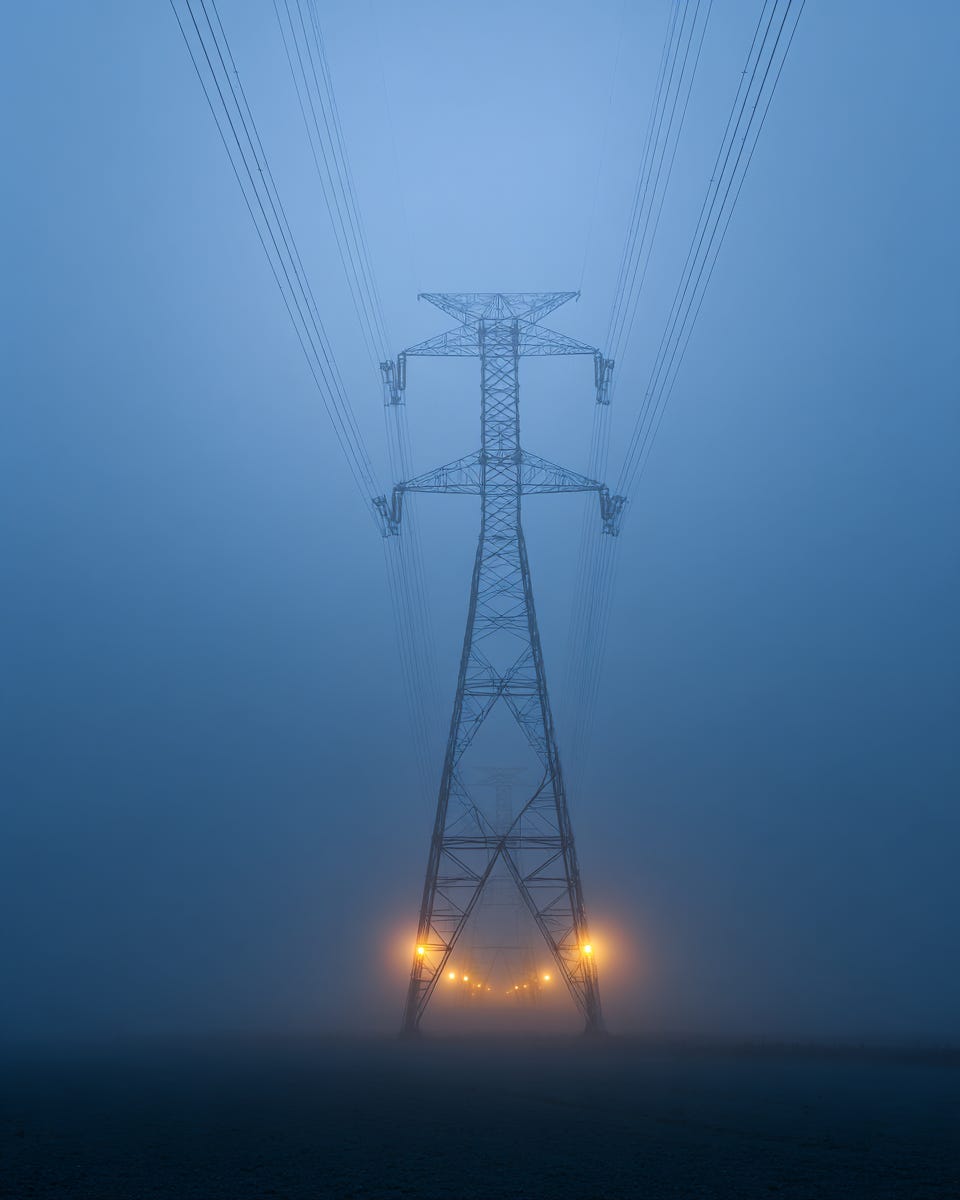
Even if the queue cleared tomorrow, the wires that would carry cleared power from where it’s generated to where it’s consumed haven’t been built.
US interregional transfer capability is roughly 84 GW. NERC says we need 35 GW more, a 40% increase, and that estimate predates the AI demand surge. China built 8,200 miles of ultra-high voltage line in the 2020s. The US built 375. Twenty-two to one. Once upon a time, transmission infrastructure was built in a few years. After decades of accumulated state and federal environmental activism, major transmission lines now take seven to twelve years to build. The engineering hasn’t gotten harder.
Paying for the Wrong Wires
What I said previously, “The Wires Don’t Exist” is partially false. There has been a great deal of wires laid over the last couple of decades. The problem is: they’re the wrong ones.
From 2012 to 2022, PJM transmission owners spent over $38 billion on a category called “supplemental projects” which have localized benefits. In contrast, they spent about $17 billion on baseline regional projects that improve regional transmission. More than two to one in favor of the local stuff. Local and supplemental spending went from 9% of PJM transmission spend before 2014 to 73% by 2021. Lack of investment isn’t the problem. It’s flowing. It’s just flowing to the wrong place.
Why?
Follow the incentives. After FERC’s Order 1000 introduced competitive bidding for large regional transmission projects in 2013, utilities lost the guaranteed right to build them. Regional projects now have to be competed for, with RTO board scrutiny, against other developers. Supplemental projects, by contrast, retained the right of first refusal. The incumbent utility builds, no competition, no review. The path of least resistance and the path of highest financial return point to the same place: small, local, in-territory work that maximizes rate base and avoids competitive procurement.
And not only do supplemental projects lack competition, they are usually compensated via “formula rates”. A formula rate is a FERC-approved mechanism where a transmission owner’s costs flow through to ratepayers via an annual administrative update, with no full rate case, no adversarial review of whether each investment was prudent, necessary, or cost-effective. Costs flow through, year after year, with no independent validation that the project was the right project, built efficiently, or preferable to available alternatives. Cost recovery without accountability.
This is rational behavior, not bad intent. Utilities are responding to the incentive structure they were given. Why compete in an adversarial and competitive regional environment when you can frictionlessly earn returns for your shareholders using your monopoly status locally? The predictable outcome from this easy decision tree is a grid that builds out a lot of local projects and very few regional ones. That is exactly what happened.
The consequence is that replacing aging 138 kV lines inside a single utility’s footprint is not the same as building the high-voltage backbone needed to move power across an RTO. The supplemental boom hasn’t relieved congestion. It hasn’t unblocked interconnection. It has produced a great deal of CapEx, a lot of rate-base growth, and very little of the regional transfer capacity NERC says we need.
Permitting: An Architecture of Strangulation
Every major energy project in the US runs a gauntlet. Federal NEPA, where Environmental Impact Statements average four and a half years and the Administrative Procedure Act lets opponents challenge the review on procedural grounds. Federal Section 401 of the Clean Water Act, where states can effectively veto interstate projects on water-quality grounds. State PUC siting, separately, in every state the project touches, with no federal override. State environmental policy acts in 16 states plus DC plus Puerto Rico, with California’s CEQA and New York’s SEQRA imposing substantive requirements on top of federal NEPA. Even in red states the layers stack: a 175 MW Montana gas plant has been in litigation for three years after its air permit was challenged under Montana’s state environmental review statute. Three years for 175 MW of gas in deep red Montana!
None of these are construction times. They are permission times. Major transmission lines: 7-12 years. Federal EIS: 4.5 years on average. New Source Review for behind-the-meter gas: 14 months even when nothing about the project is controversial.
The permitting layers explain a lot of our woes. The queue cascades because every network upgrade has to run NEPA again and every NEPA review is litigable. The interregional grid doesn’t get built because there is no federal backstop for state PUC vetoes, so a single state can kill a multi-state line. The over-allocation toward supplemental spending is partly an incentive story and partly a permitting story, supplementals stay inside an existing right-of-way, qualify for categorical exclusions, and avoid the review gauntlet that regional projects can’t escape. The incentive architecture and the permitting architecture compound each other.
NEPA was passed for real reasons. Section 401 protects real water. State PUC siting reflects real federalism, and the postwar buildout displaced communities and dismissed environmental concerns more readily than is acceptable now. The argument isn’t that the prior architecture was costless. It’s that the current architecture has overshot so far that even its major solution, abundant and cheap clean-energy, is being strangulated by it. It needs to be prudently pruned.
The good news is the legislative response emerging. The SPEED Act, which reforms NEPA, passed the House in December 2025 and is awaiting 60 Senate votes. The SPEED and Reliability Act addresses transmission siting directly with a federal backstop for projects meeting national-interest criteria. Whether either passes is an open question.
Cautiously Optimistic
The political right has never been the major bottleneck on these issues. But now, a bipartisan coalition is forming thanks to solar projects being boxed in with no way out but comprehensive reform on transmission and permitting. The congressional left will have to choose abundant solar energy or keeping their permitting architecture in place. They can’t do both. This tension will separate the de-growthers from the clean abundance types. Hopefully the latter are victorious.